During the recent ASLAN 2026, held in Madrid in March 2026, Carles Xavier Munyoz, CEO of SOLTECSIS Soluciones Tecnológicas, had the opportunity to present a real-world digital transformation case study in the Public Administration sector. The project, developed for Castrillón Town Council, was also a finalist in the awards organised by the congress itself within this category.
The talk showed how a local authority can modernise its technology infrastructure to improve the availability of its municipal services, strengthen security, and lay the foundations for a more scalable, efficient environment that is ready for the future.
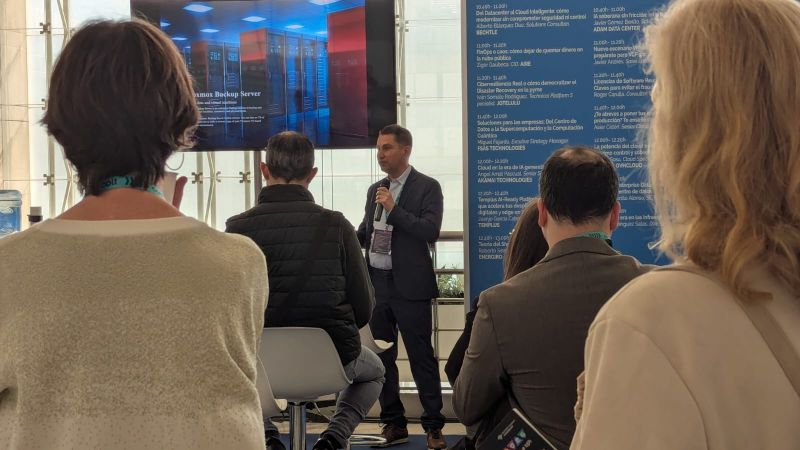
The session began by discussing Proxmox VE and its current impact on companies and public administrations, positioning it as a solid alternative to other hypervisors on the market. An open, flexible virtualisation platform that is increasingly present in environments where stability, scalability and infrastructure control are key factors.
This is where SOLTECSIS comes in, thanks to its extensive experience working with Proxmox VE on projects of different types and sizes. In the case of Castrillón Town Council, SOLTECSIS supported the client throughout the entire project lifecycle: from the initial architecture design to the physical installation of the servers, the deployment of the Proxmox clusters, the definition of the disaster recovery plan, security, and the business continuity strategy.
Ultimately, it was not simply about implementing a virtualisation platform, but about building a complete virtualisation solution with Proxmox, designed to meet the real needs of a public administration.
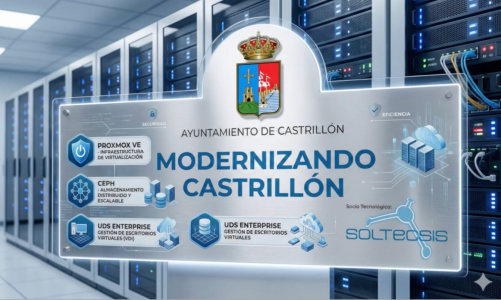
The talk then went on to review some of the project’s strongest points and the advantages delivered by this new infrastructure.
Proxmox VE with Ceph
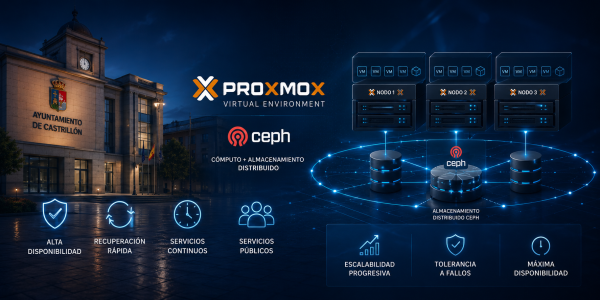
One of the main elements was the use of Proxmox VE with Ceph, a combination that enables the deployment of highly available hyperconverged clusters. This architecture integrates compute and distributed storage into a single platform, reducing dependence on traditional storage arrays and making it easier to scale the infrastructure progressively.
Thanks to this approach, the public services of Castrillón Town Council can remain operational for longer and recover more quickly in the event of an incident.
High availability is not just a technical improvement; it is a guarantee that municipal services can continue running even when part of the infrastructure fails.
Backups
Another key point of the project was the backup system, as Carles pointed out during the talk. SOLTECSIS implemented Proxmox Backup Server, the native backup solution within the Proxmox ecosystem, which enables efficient, deduplicated and secure backups of virtual machines and containers.
This protection layer provides the Town Council with a reliable backup in case information needs to be recovered, a virtual machine restored, or a rollback performed after an incident. In addition, the project was reinforced with an online replica of the infrastructure, designed to speed up recovery in the event of a physical disaster and improve the continuity of critical service
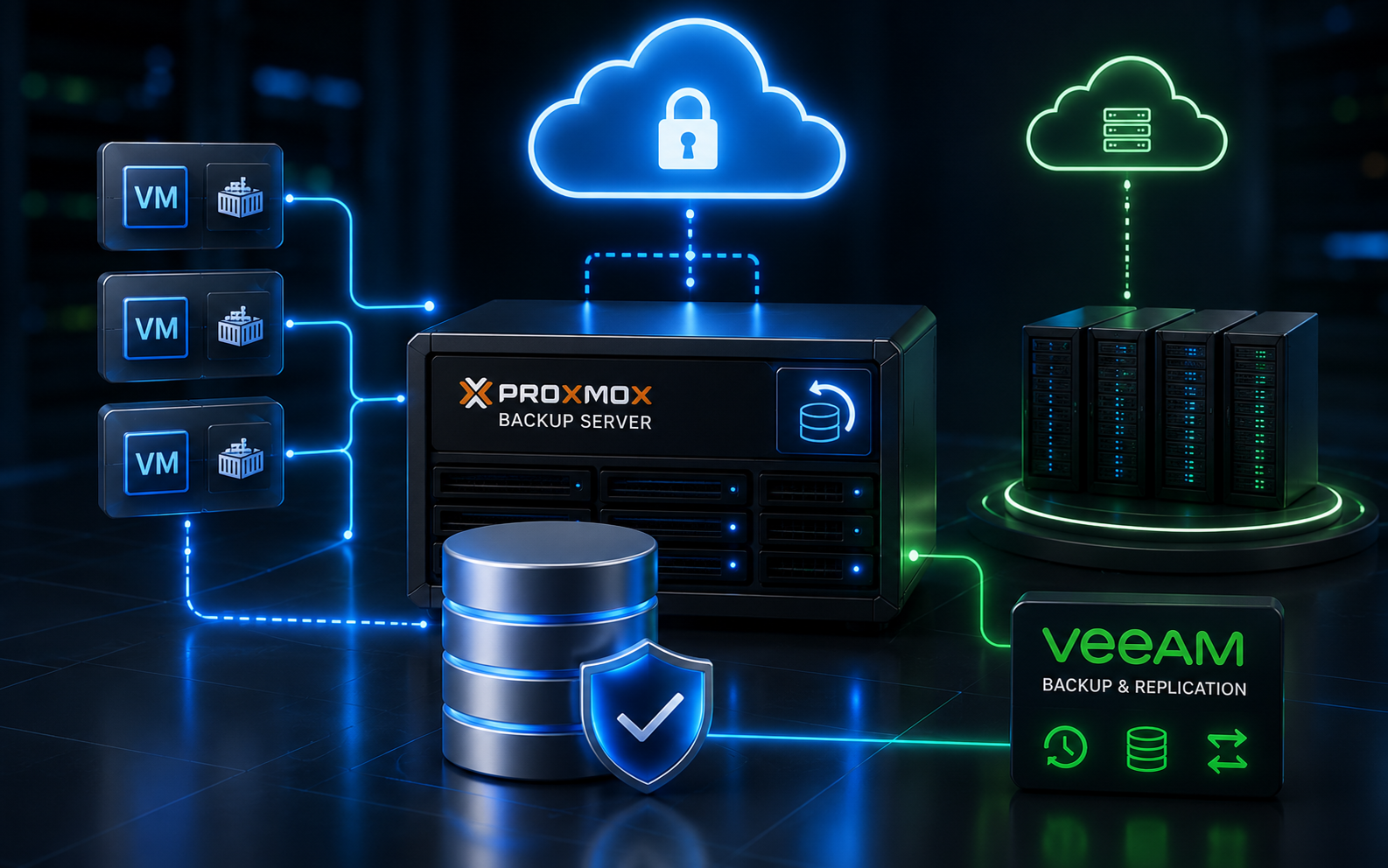
All of this was complemented by Veeam Backup & Replication, a widely used tool in enterprise environments for strengthening backup, recovery and replication strategies.
In this case, Veeam provides an additional layer of protection through backups stored in an immutable repository, reducing the risk of accidental or malicious modification or deletion of backups.
The project combines two different backup technologies: Proxmox Backup Server, aimed at protecting the infrastructure, and Veeam Backup & Replication, focused on data protection. In this way, the Town Council has its systems and data backed up using two complementary approaches, increasing its recovery capabilities in different failure scenarios.
DRP
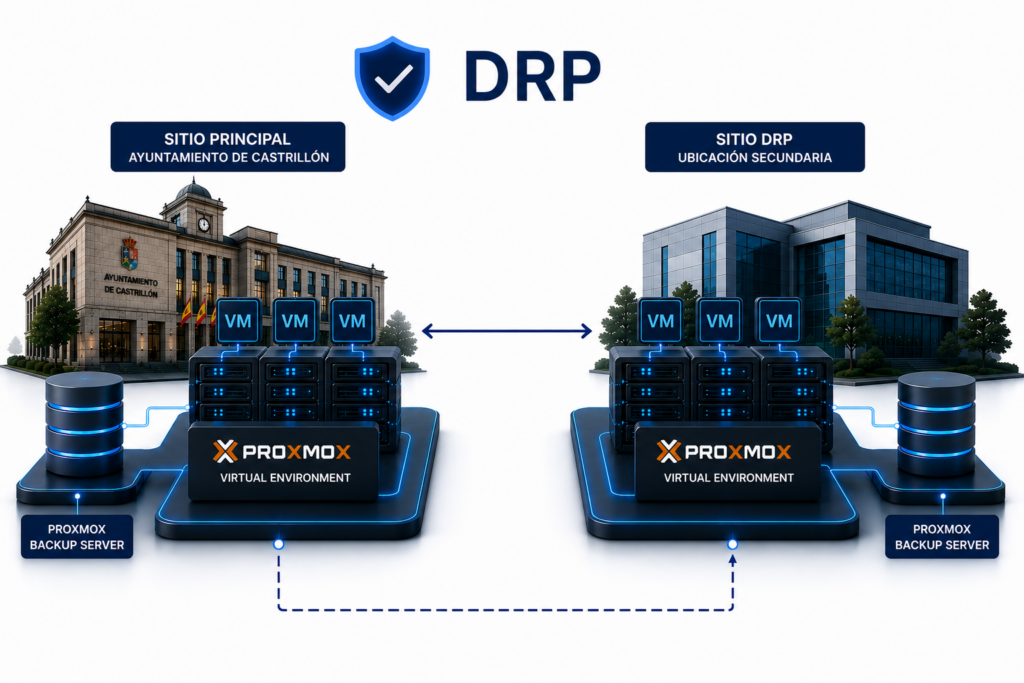
After covering the backup section, Carles continued the talk by discussing the DRP, or Disaster Recovery Plan. He first introduced the concept, explaining its importance within any critical infrastructure: a disaster recovery plan defines how to respond to a major outage, a physical failure, a cyber incident, or any situation that could compromise service continuity.
The DRP designed for Castrillón Town Council was then discussed, also making use of part of its existing facilities.
This strategy made it possible to define a more comprehensive recovery scenario, focused on reducing downtime and ensuring that essential services can be restored in the shortest possible time.
UDS Enterprise
During the talk, the implementation of UDS Enterprise as a tool for managing virtual desktops was also discussed. This solution provides public employees with secure, centralised access to their workstations, making the environment easier to manage, improving access control, and offering greater flexibility in the use of technology resources.
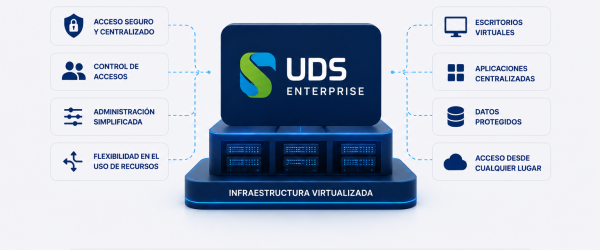
Workplace virtualisation provides an important advantage in public sector environments, as it helps simplify day-to-day management, improve security, and enable users to access their applications and desktops in a controlled way, regardless of the device or location they are working from.
To close the talk, Carles dedicated a few words to one of the elements that has made this project, and many others, possible: the magic of Open Source.
Open source has been one of the great silent forces driving the evolution of the Internet, modern technology infrastructure, and thousands of projects around the world. It is not just about open code, but about collaboration, transparency, technological independence, and the ability to build robust solutions without being tied to closed models.
The case of Castrillón Town Council shows that, when designed with sound judgement and implemented with experience, open source can become the foundation of modern, secure critical infrastructures that are ready to grow.